

I) Significant New Development - DEP Concedes
The Sherrill DEP quietly issued a notice on the DEP website that DEP would begin limited sampling for vapor intrusion risks this week in Keyport, NJ, see:
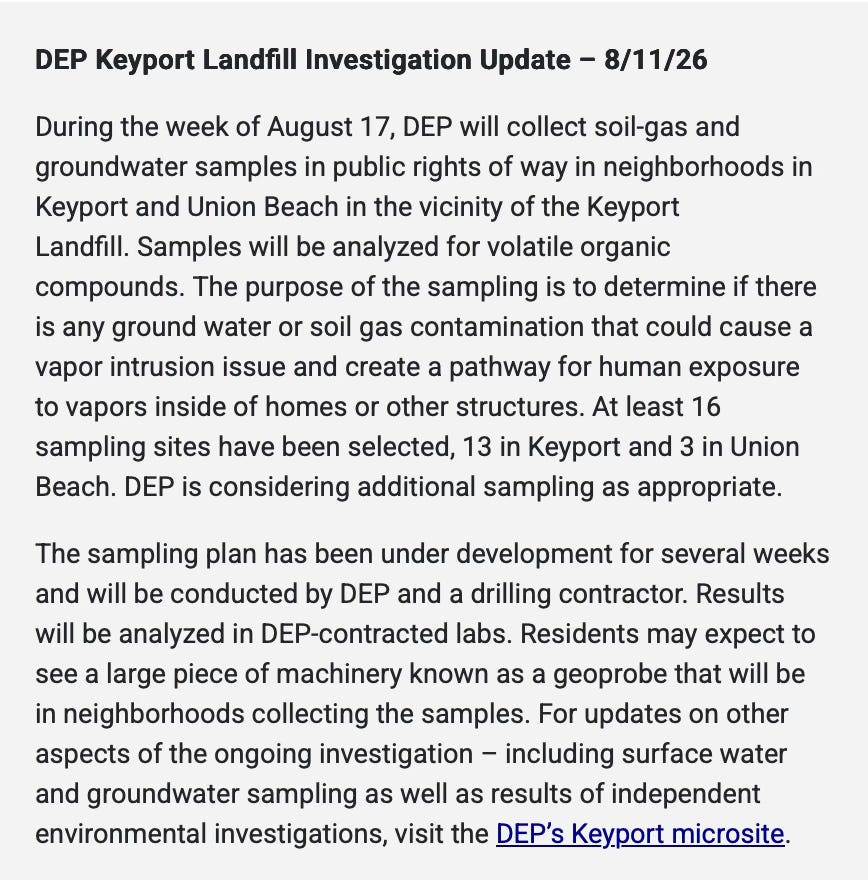
I say reluctantly because I flagged the vapor intrusion issue months ago: (April 24, 2026):
The most likely route of exposure of residents in Keyport is from what is known as “vapor intrusion” (VI) - the subsurface migration of toxic gases and groundwater pollution into buildings.
Residents have been demanding sampling of the indoor air in their homes for months as well.
I say limited because DEP sampling locations are in “public right of way” instead of under the slabs of houses without basements and inside the basements of houses that have them. DEP’s own Vapor Intrusion Guidance and remediation regulations require this sampling.
Unfortunately, Keyport is another in a Statewide series of DEP mismanagement of the vapor intrusion issues - for the history and receipts on that, see:
II) “Pulitzer chasing”or “prize-baiting”?
But a major new problem I’ve found in Keyport is with the media.
Incredibly, instead of reporting the DEP obfuscation, deception, and failure to warn the public about these risks, they are contributing to it.
And I think NJ.com is doing so intentionally to maximize the journalistic values of the story, by what’s known as "dole-out journalism" or "drip-feeding" a story.
When this behavior is driven specifically by the desire to maximize prestige, construct a narrative arc, and qualify for an industry prize (like the Pulitzer Prize), it is critically and colloquially referred to in newsrooms as "Pulitzer chasing"or "prize-baiting"
And that is exactly what NJ.com is doing. I have had several email exchanges with their reporter and she knows all about the vapor intrusion issues and is simply holding off on reporting them.
While investigative journalism projects like Keyport legitimately require multi-part rollouts due to complex facts, the strategic delaying or manipulating the release of vital public-interest data solely for self-promotion or financial gain violates core journalistic ethics.
If a reporter saves major revelations specifically to package them later for a personal book launch rather than daily news, it is called "holding back a scoop" or "hoarding" the news.
Withholding information that impacts public health risks is universally considered a severe breach of journalistic ethics. When imminent public danger, contamination, disease outbreaks, or safety hazards are involved, a journalist's primary civic duty changes from storytelling to harm reduction.
The “Minimize Harm” Imperative: The Society of Professional Journalists (SPJ) Code of Ethics mandates that journalists must “balance the public’s need for information against potential harm or discomfort”. Intentionally delaying life-saving details to create a more compelling narrative or chase awards shifts the outcome from “discomfort” to preventable physical harm or death.
Public Interest Priority: Organizations like the Association of Health Care Journalists (AHCJ) emphasize that the public interest must be the primary criterion when choosing when and how to report. Withholding data forces the public into an involuntary risk, violating their personal autonomy to make informed health choices.
III) Science and Ethics - A Duty To Warn
Perhaps worse, it seems that scientists from NYU, who are conducting sampling and providing scientific advice to NJ.com on this story, are being sucked into this unethical journalism.
I contacted the NJ.com editors and reporter, the NYU press office, and wrote to the NYU scientist yesterday.
The lead NYU scientist has a PhD in toxicology and a research focus on “inhaled toxicants”. So how could she not be warning the public about vapor intrusion?
Why did she send a graduate student to conduct sampling of soils for heavy metals? Why was this the focus on NJ.com’s reporting?
They have not responded [Update: I just got an acknowledgement reply from nj.com editor via 8:35 am email. He pledged to discuss my concerns with editors on the story and get back.], so here is my letter:
Dr. Zelicoff - I understand that you are working with NJ.com on sampling in Keyport NJ. I’ve been in touch with Karin for several weeks now and am getting frustrated by what appears to be failure to warn.
I note that your research focus as a toxicologist is on “inhaled toxicants”, thus I am baffled about why NYU is conducting heavy metal soil sampling. There seems to be a complete blackout of the risks of potential vapor intrusion into buildings by VOC’s from the Aeromarine landfill, given:
1) extremely high levels of VOCs found in soil gas in the 2010 remedial investigation that exceeded DEP vapor intrusion screening levels and triggered followup sampling of sub slabs and indoor air:
2) the July 2026 samples also found soil gas levels at the landfill for VOCs that exceeded DEP screening level by orders of magnitude, and triggered followup sampling of sub slabs and indoor air: see:
3) DEP’s most recent scope of work includes “public right of way” but not indoor air or sub slab locations, which appears to conflict with DEP’s own VI Guidance protocols.
I made all this public back on May 1 when I wrote:
“the 2010 remedial investigation detected extremely high levels of cancer causing VOC’s, including exceedances of benzene standards 90% of the time. RI Report:
“Soil gas analytical results indicate the following:
Benzene is reported above the soil gas screening level (SGSL) at nine of ten sample locations with concentrations ranging from ND in SG-F8 to 1,086.19 micrograms per cubic meter (ug/M3) in SG-I2.
Vinyl Chloride is reported at seven of ten sample locations with concentrations ranging from ND in SG-F8 to 1,584.87 ug/M3 in SG-B3.
Chloroethane is reported at three of ten sample locations with the highest concentration of 105,554.19 ug/M3 at SG-H7.
Dichloroethane and cis-1,2-dicloroethene are reported at one location (SG-B3) at concentrations of 4,791.49 ug/M3 and 4,757.79 ug/M3, respectively.“ (page 3 - 10)
The DEP soil gas screening level for benzene is 18 ug/M.
The DEP Indoor Air remedial standard for benzene is far lower, 0.64 ug/M3.
The levels detected at the Aeromarine landfill were 17,000 TIMES this DEP indoor air health based remedial standard (based on a 1 in a million individual lifetime cancer risk).
The levels were 60 TIMES higher than the DEP soil gas screening level for benzene.
The DEP Vapor Intrusion Guidance document explains the risks of landfills and vapor intrusion: 2.3.5.2 Landfill Gases”
FYI, I reached out to the NYU press office this morning to raise concerns that you may inadvertently being sucked into a journalistic drip tactic that is deeply unethical.
Can you explain all this? What is the status of your sampling for VOC in subsoil and homes? When will it be made public?
Bill Wolfe