

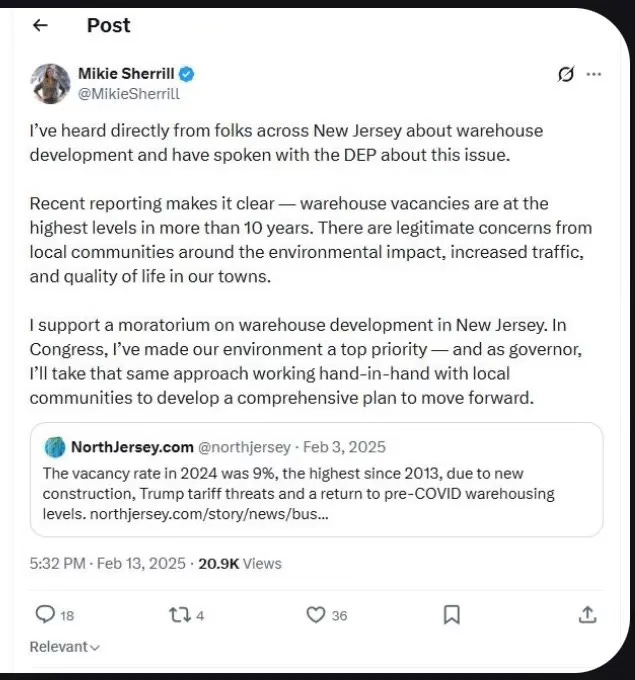
“I support a moratorium on warehouse development in New Jersey. In Congress, I’ve made our environment a top priority - and as governor, I’ll take the same approach working hand-in-hand with local communities to develop a comprehensive plan to move forward.” ~~~ Gubernatorial candidate Mikie Sherrill Feb. 13, 2025
Gov. Sherrill now faces an important test of whether she will uphold the integrity of the Highlands Act, block abuse of power by the Highlands Council, and honor her campaign commitments, i.e.:
“I support a moratorium on warehouse development in New Jersey.”
The Gov. is beginning to get some heat on whether she will exercise her veto power under the Highlands Act to block a controversial proposed new warehouse “redevelopment” on farmland approved by the Council, see:
The roughly 57-acre plot of land sits between the old Phillipsburg Mall and a creek that runs parallel to Route 22.
The council approved the plans on May 21, allowing construction of a roughly 360,000-square-foot warehouse to move forward in the planning process.
An online petition is urging Sherrill to issue a veto. It has garnered more than 2,100 signatures.
Environmental advocates are pushing to protect the property, saying the council’s approval is a workaround to strip protections from farmland in a protected zone.
“It’s so awful,” said Mike King, chair of the Phillipsburg Riverview Organization. “It’s a scheme to develop farmland that is actually off limits.”
As I’ve written several times, the Council’s approval stands the Highlands Act on its head and is a perverse abuse of power in how it designates farmland as “redevelopment”, see:
The Highlands Act, enacted to protect the water supply for 5 million NJ residents from over-development, set a very strict standard for lands that could qualify for redevelopment.
In drafting the Highlands Act, the Legislature was well aware of how local governments had abused the power to designate lands “in need of redevelopment” under local zoning authorized by State laws. Those laws lack standards to prevent abuse, leading to many examples where undeveloped farmlands and forests were designated as in need of “redevelopment” and lost to massive development projects.
To prevent that kind of abuse in the protected Highlands region, the Highlands Act set a strict standard to assure than “redevelopment” only occurred on previously developed lands. The Act sets a standard requiring that 70% of the property be covered by impervious surfaces, e.g. parking lots, roads, buildings, etc.
In order to meet that 70% impervious cover standard for undeveloped farmland, the Highlands Council staff used the totally paved over developed land of a nearby major mall and parking lot.
If allowed to stand, this would set a dangerous precedent that could allow leapfrog “redevelopment” to consume thousands of acres of farmland and forests in the Highlands.
This is not a loophole in the Act, it is an error and outrageous abuse of discretion by the Highlands staff and Council.
This is exactly the kind of “runaway Council” action that the Gov. was provided authority in the Highlands Act to veto.
The Gov. must uphold the integrity of the Highlands Act.